Mali Mann, a child, and adolescent psychoanalyst & psychiatrist, reminds us of the power of fantasy. All of us who work with young children have witnessed first-hand the role of fantasy in young children’s lives. For example, we all know how many young children these days are fascinated by the story, Frozen, a story that depicts sibling love and rivalry, bonding within a family and venturing out into the world. Other children, particularly boys, are endlessly fascinated by superheroes. She illustrates how fairy tales and myths teach children the dos and don’ts as well as the customs of their communities. She comments on other writers who stress that the myth of the hero represents masculine success. “Can we conjecture that myths glorify men’s accomplishments, while fairy tales focus on women?” She highlights various psychological states depicted in the story of Little Red Riding Hood.
Since Bruno Bettelheim, in The Uses of Enchantment: The Meaning and Importance of Fairy Tales stressed the value of fairy tales, myth and enchantment, there has not been enough interest in the importance of fairy tales on children’s development. This article directs our attention to the ubiquity of fairy tales in children’s literature and their influence on identity formation. Fairy tales depict a variety of social constructs and attitudes. The story of “Little Red Riding Hood,” for example, which I will highlight, warns of the dangers that can befall young women if they stray too far away from safety.
Fairy tales portray a variety of experiences that support the development of children’s character. They suggest that, despite adversity, a rewarding and good life is possible, if one does not run away from the hazardous struggle. These stories promise that if a child courageously engages in a taxing search, benevolent powers will help them succeed. The stories also warn that those who are too fearful may risk having to settle for an ordinary life. Today many children meet fairy tales in film and TV where they are depicted in a frivolous, beautified, and simplified manner that masks their deeper meaning.
The myth of Oedipus, for example, highlighted by Freud, dramatized age-old problems inherent in our complex, ambivalent feelings about our parents. In fairy tales, internal processes are externalized and rendered more comprehensible as represented by characters of the story and their challenges. Fairy tales do not describe the world as it is, nor do they instruct children what they ought to do. Rather, fairy tales are helpful because children can find their own solutions by contemplating what the story implies about their own inner conflicts.
Fairy tales, folk legends, and myths embody the collective experience of a society, transmitting past wisdom to future generations. In fairy tales, figures and events personify and express universal inner conflicts. They offer in a subtle manner how conflicts might be solved.
A child learns from fairy tales that figures who seem threatening, parents or strangers, might magically change into helpful friends. Belief in the truth of fairy tales inspires courage and hope, despite the ominous appearance of strangers. For example, the hero of many fairy tales succeeds in life because of their courage in befriending an unpleasant figure. Fairy tales both delight and instruct children by allowing them to project their need for protectors in the stories. This allows children to create their own versions of tales out of the chaos in their own minds or family situation.
However, fairy tales can also be damning: For instance, the evil queen from Snow White demands the secret murder of her stepdaughter after a magic mirror proclaims the younger woman’s beauty. The stepmother from Hansel and Gretel sends her stepchildren into the woods because there is not enough to eat. Cinderella sits amid her fireplace cinders, sorting peas from lentils, her ash-speckled body appeasing a wicked stepmother who wants to dull her luminosity with soot.
Joseph Campbell observed in The Hero with a Thousand Faces that the accomplishment of the mythic hero represents macrocosmic human triumphs. On the other hand, the protagonist of the fairy tale achieves a domestic, microcosmic triumph that appears to be a personal victory. Can we conjecture that myths glorify men’s accomplishments, while fairy tales focus on women? According to Otto Rank, mythic heroes are never female. Campbell limited his early analysis to male heroes, although many of his examples were female. He acknowledged childbirth as one form of heroism.
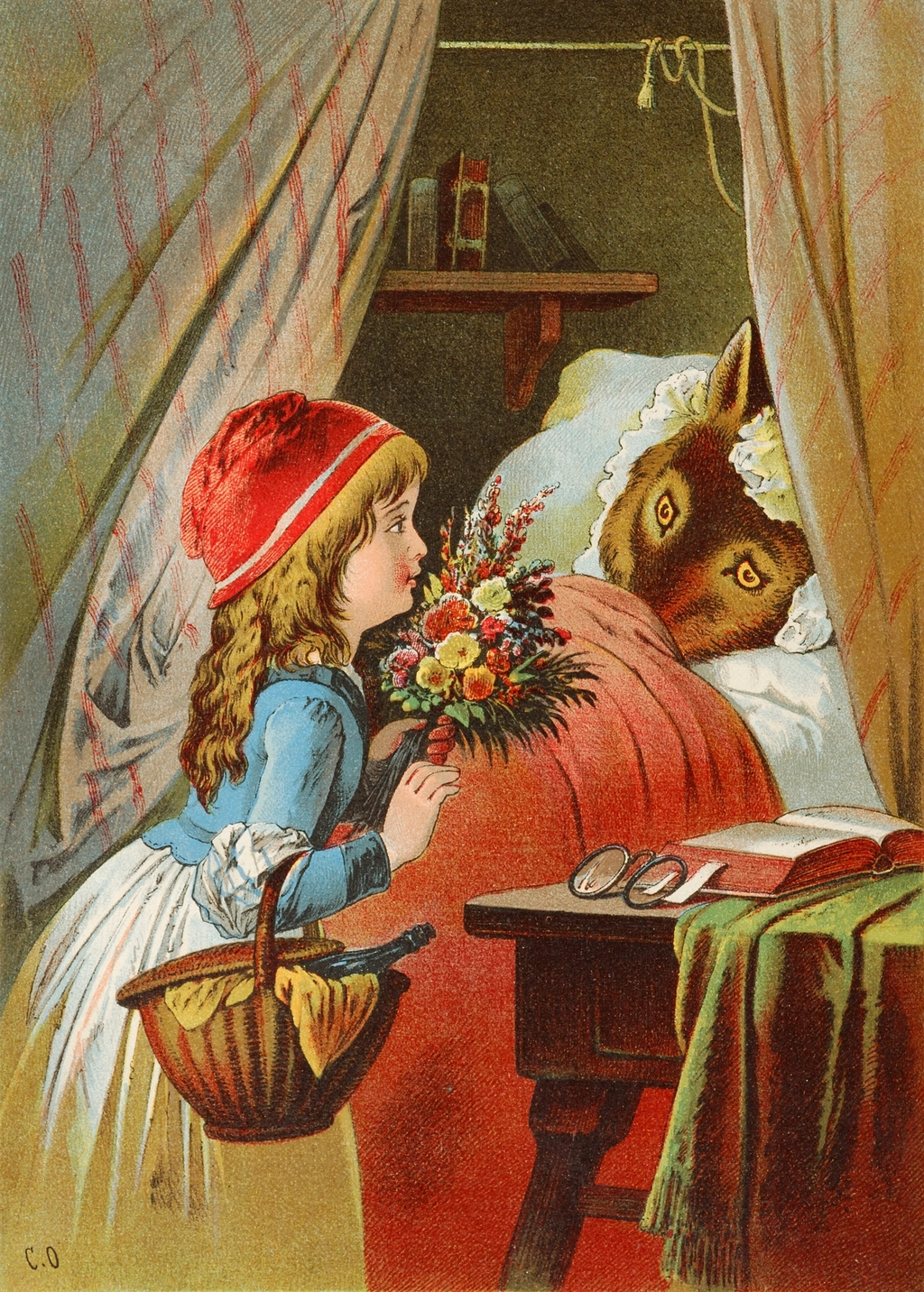
Little Red Riding Hood is one of the fairy tales that potentially has various effects on children’s ego maturation and their fantasy world. The original folk tale depicts an unnamed peasant girl who meets a werewolf on her way to visit her grandmother.
The wolf asks the little girl whether she is taking the path of pins or needles. She indicates that she is on her way to becoming a seamstress by taking the path of needles. The werewolf quickly departs and arrives at the grandmother’s house, where he devours the old woman and places some of her flesh in a bowl and some of her blood in a bottle. After the peasant girl arrives, the werewolf invites her to eat some meat and drink some wine before getting into bed with him. Once in bed, she asks many questions until the werewolf comes close to eating her.
She insists that she must go outside to relieve herself. The werewolf ties a rope around her leg and sends her through a window. In the garden, the girl unties the rope and wraps it around a fruit tree. Then she escapes and leaves the werewolf holding the rope. In some versions of this folk tale, the werewolf eats the girl. But the girl proves that she can fend for herself.
In Perrault’s version Little Red Riding Hood appears spoiled and naïve. She wears a red cap – in older versions the story is called Little Red Cap. Red symbolizes violent emotions, including sexual impulses. The tale – in its many versions – expresses a warning: girls who invite strange men into their parlors deserve what they get.
Little Red Riding Hood offers a variety of archetypes: the contrast between the evil wolf and the innocent girl. She is human and thereby represents the civilized world, while the beast is wild. She is young, her grandmother old. The forest represents the unknown, and their home represents safety, society, and family. The narrative also demonstrates the emerging sense of independence. Our identity, and [sense of self changes with time and, as the fairy tale intimates, inversions are part of human nature.
Fairy tales run through us like a current from one generation to the next. They communicate, often unconsciously but powerfully, psychological truths and struggles. Our intuitive understanding tells us what it means to be a wolf, grandma, woodsman, and Little Red Riding Hood. Fairy tales, like Little Red Riding Hood, offer lessons in safety, vulnerability, and the need to exercise wise choices in the face of danger.
Fairy Tales and Their Impact on Children’s Development
Mali Mann, a child, and adolescent psychoanalyst & psychiatrist, reminds us of the power of fantasy. All of us who work with young children have witnessed first-hand the role of fantasy in young children’s lives. For example, we all know how many young children these days are fascinated by the story, Frozen, a story that depicts sibling love and…
5–7 minutes
