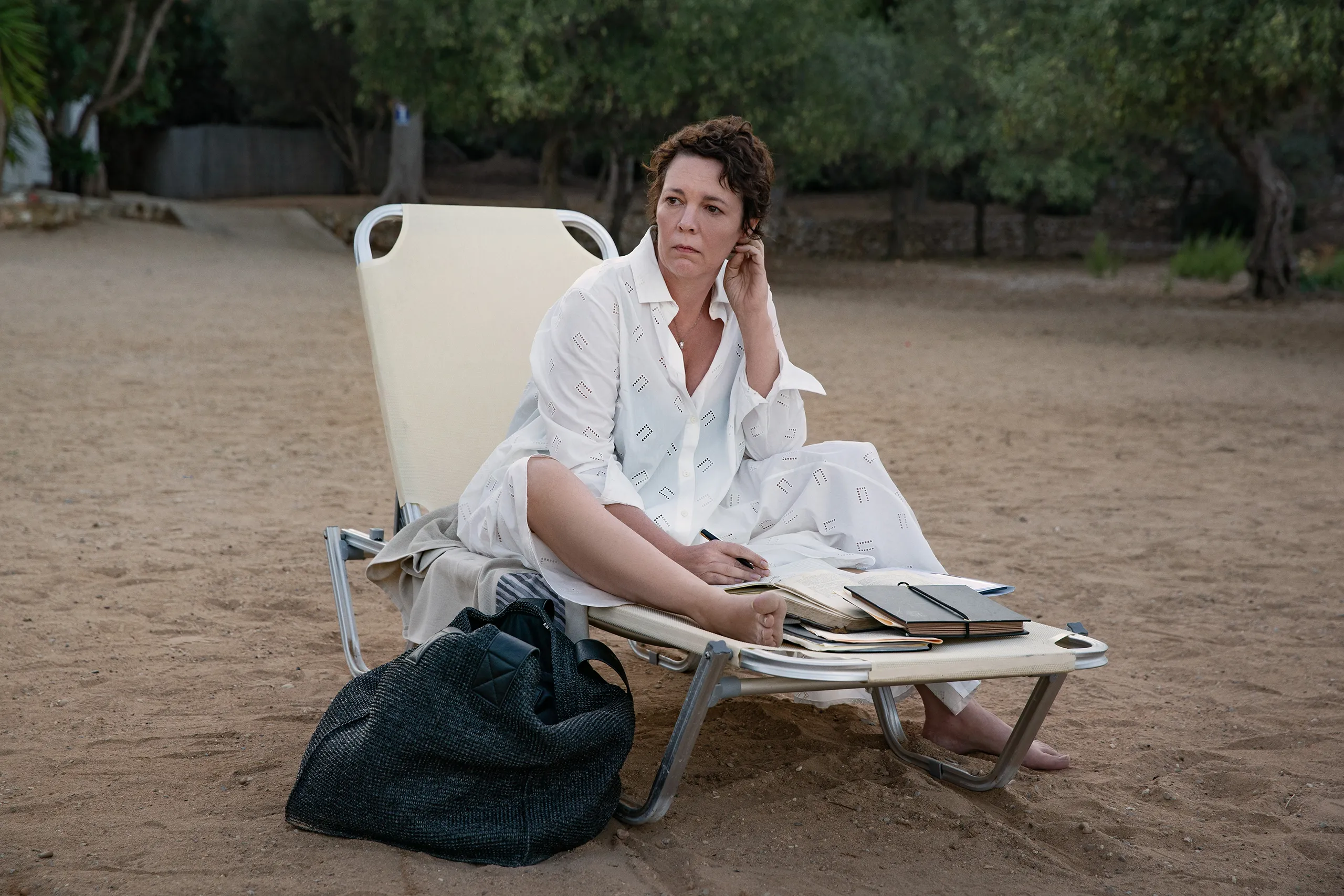
This year we had the pleasant surprise of watching the movie The Lost Daughter, an adaptation of Elena Ferrante’s book of the same name, directed by Maggie Gyllenhaal.
In this exquisite adaptation of Ferrante’s controversial reflections, the film focuses, not coincidentally, on the unspeakable anxieties and social pressures that motherhood and the feminine have always suffered. For Ferrante’s readers, it is known that the text explores much more than the endless struggle for a social position of the feminine.
In her work, the author reveals the complex relationship between mothers and daughters as well as the relationship between generations of women, while also considering the intricate interconnections between the feminine and the culture. She also explores female sexuality and especially the interrelation between narcissism, desire, and love.
Before we enter into the possible readings about the narrative of Leda’s life, it would be interesting, although risky, to differentiate between maternal desire and its function, as Jacques Lacan proposed to us, and maternal love.
Since the beginning of the 19th century, we observed an idealization of the maternal, which Colette Soller describes as the maternal “communitary utopies”, that led woman/mothers to be categorized as obsessive, possessive, oblivious or disconnected, adequate or not. The socially described maternal love is not, however, what defines the subject. Instead, the mother’s desire is at the core of the emergence of the subject – the woman who is incomplete and therefore will never fully satisfy her child’s desire leads to the operation that initiates the existence of a barred subject and an object that is the source of its desire.
Leda’s character and her harrowing journey show us this separation very well. What is not very clear about Leda in the film overflows in Ferrante’s book. Leda, much like the doll she abducts, was inanimate, empty of a maternal desire. Leda tells us in a recurring way that her daughters, her husband, and even the Neapolitan family, subtract from her something essential. She carries inside an ongoing experience of expropriation. Any desire, however minimal, that is addressed to her is felt as something that will rip her apart. In the film, we see several scenes of her agony as she struggles to take care of her daughters or her house as well as the discomfort she feels in the presence of other female characters in the plot.
Moments of comfort and joy will appear when her desire as a woman is prioritized and invoked by male figures. She conveys that being a desiring/object was easier than being a mother/castrated and therefore unable to sustain and transmit the position of a barred subject. In the film, Leda’s mother was mentioned briefly. In her book, however, there are abundant descriptions of how much Leda struggles to not follow her mother’s steps, which she does by trying to become only a woman while her dread for the maternal role arises, much beyond the difficulties that are real to this experience. Her desire may only exist in relating with men and books.
Maybe Leda never wanted to be a mother? It is possible. However, it is not clear whether there was hope in the desire to be a mother (Soler,2005, p.98) or if simply her regrets and her anguish would throw her directly into social assumptions about maternal malice. What is evident is the constant emptiness she experiences. The author recounts beautifully that Leda spent a few hours wishing to hear their daughters’ voices over the phone, and when the daughters finally made a call, she felt dead. We understand more about this dilemma when we learn about Leda’s registering of her mother’s anguish and the ways in which she experiences herself in a position of object/waste. The horror of the maternal choices drop her into a void and prevent her to find other desiring ways of living motherhood. We notice her horror for the maternal position.
Leda was very envious and extremely competitive against everything related to the feminine. Single, married, attractive, ugly women, mothers or not, were annoying to her. She was deeply disturbed by her adolescent daughter’s attracting the male gaze – she did not want them to be participants of the women’s desire. Nothing related to the feminine escaped her, leaving the male characters as supporting actors in her endless narrative in which it was possible to desire, to be desired, or to be dead. But why could a woman only be either in the register of what is maternal or in the register of what is feminine? Could those two registers co-exist, even if bearing necessary struggle?
Leda could never work through the fact that desire and love are not the same thing. Desire is, by definition, the trace of a fundamental lack while love is the incessant experience of lack, again and again. After all, to love is the ongoing assumption of a desire which is always a desire for something else. Based on the Lacanian statement that the subject is supposed to be in love with what the other does not have, Leda would have been able to re-create this narrative and find another solution to her solitude. It is possible to offer what one did not have as long as one may find a way to make sense of what one received.
References:
Ferrante, E. (2016). A filha Perdida. Tradução de Marcello Lino. Rio de Janeiro. Intrínseca.
Roudinesco, E. e Plon, M. (1998). Dicionário de Psicanálise. Tradução de Vera
Ribeiro e Lucy Magalhães. Rio de Janeiro. Jorge Zahar Editor LTDA
Soler, C. (2005). O que Lacan dizia das mulheres. Tradução de Vera Ribeiro. Rio de Janeiro. Jorge Zahar Editor LTDA.
