Maurice Jean Jacques Merleau-Ponty (1908-1961) was a French existentialist philosopher and a strong proponent of phenomenology in post-war France. His work focuses on embodiment, perception and ontology. He was interested in clarifying the relationship between mind and body and made important contributions in the philosophy of art, history, language, nature and politics. He sought to integrate phenomenology with Gestalt psychology, Psychoanalysis, Marxism and Saussurian linguistics. He was influenced by Bergson, Heidegger, as well as Sartre and Simone de Beauvoir, with whom he contributed in “ Les Temps Modernes”. He in turn was a strong influence on Michel Foucault, Gilles Deleuze and Jacques Derrida. But by far, his major work was “The Phenomenology of Perception”. In his last work, “The Visible and Invisible”, he introduces the concepts of “chiasm” and “flesh” which both become important philosophical tenets.
The Question of the Visible-Invisible
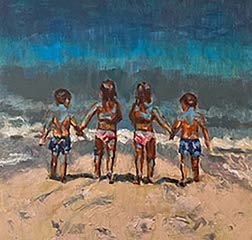
He moves away from Rene Descartes famous quote of “I think therefore I am” to the in “the body” primacy site of perception where the body is the primary site of knowing the world. Consciousness and the body can’t be disentangled from each other in the process of knowing and perceiving. Consciousness, he tells us, is not located in the brain or heart. It is also not located outside of the body. Consciousness is the interplay, the action. Simone de Beauvoir’s states in dialogue with Merleau Ponty, “The body is not a thing, it is a situation: it is our grasp on the world and our sketch of our project.” My focus is on how perception is an aesthetic experience and how the perceptual experience can be analogously applied to psychoanalysis as well as to painting. Both psychoanalysis and painting are explorations. They are attempts at articulating the many aspects of human life. “Essence and existence, the imaginary and the real, the visible and the invisible” are all perceptions that unfold In our lives seeking meaning. It is not only in our minds but it is also in our bodies that these perceptions interact with other minds and bodies in an exchange of energies which brings us to the concept of “Chiasma”. In the work of Merleau Ponty, the chiasma describes a pattern that is five-fold. The conceptualization moves away from an ocular visual metaphor to a tactile immersion through the chiasma and into the body. The chiasma connects the visible with the invisible, or the perceptual with mental phenomena, which creates a perceptual experience in second place. This experience may be translated as a tactile experience, touch in the third place, and subsequently in the fourth place, and through a linguistic flux, we can give meaning to the process in words. Two people or two experiences may interact in this dynamic experience. Merleau Ponty’s analysis centers on bodily presence, representation and feelings in the context of experience. Similarly, the artist/psychoanalyst experiences the world through the body and draws the world in its totality. This cosmic model of representation is known as “Gestalt”. Embodiment has its own energy and feedback between sites in patient and therapist and the therapy itself/ or painter and his model and his artwork. Sensory experiences are grounded in the body. For this paper, I’m focusing on a painting of children running into the ocean, an image that gives a feeling of a tactile experience, the bodies become mirror images of each other with an invisible connection and vibration. In psychoanalysis, the same can be experienced by an analyst putting into words the latent communication between patient and therapist, giving meaning to the communication and making the connection vibrant.
References:
Carman, T. & Hansen, M. (2004) The Cambridge Companion to Merleau Ponty. Cambridge University Press: Cambridge.
Carman, T. (2020). Merlau Ponty by Taylor Carman. Routledge: London.
Judkins, R. (2016). The art of creative thinking. 89 ways to see things differently. Penguin Random House: New York.
Ponty, M (1968). Visible and Invisible (Studies in Phenomenology and Existential Philosophy). Northwestern University Press: Evanston, IL.
