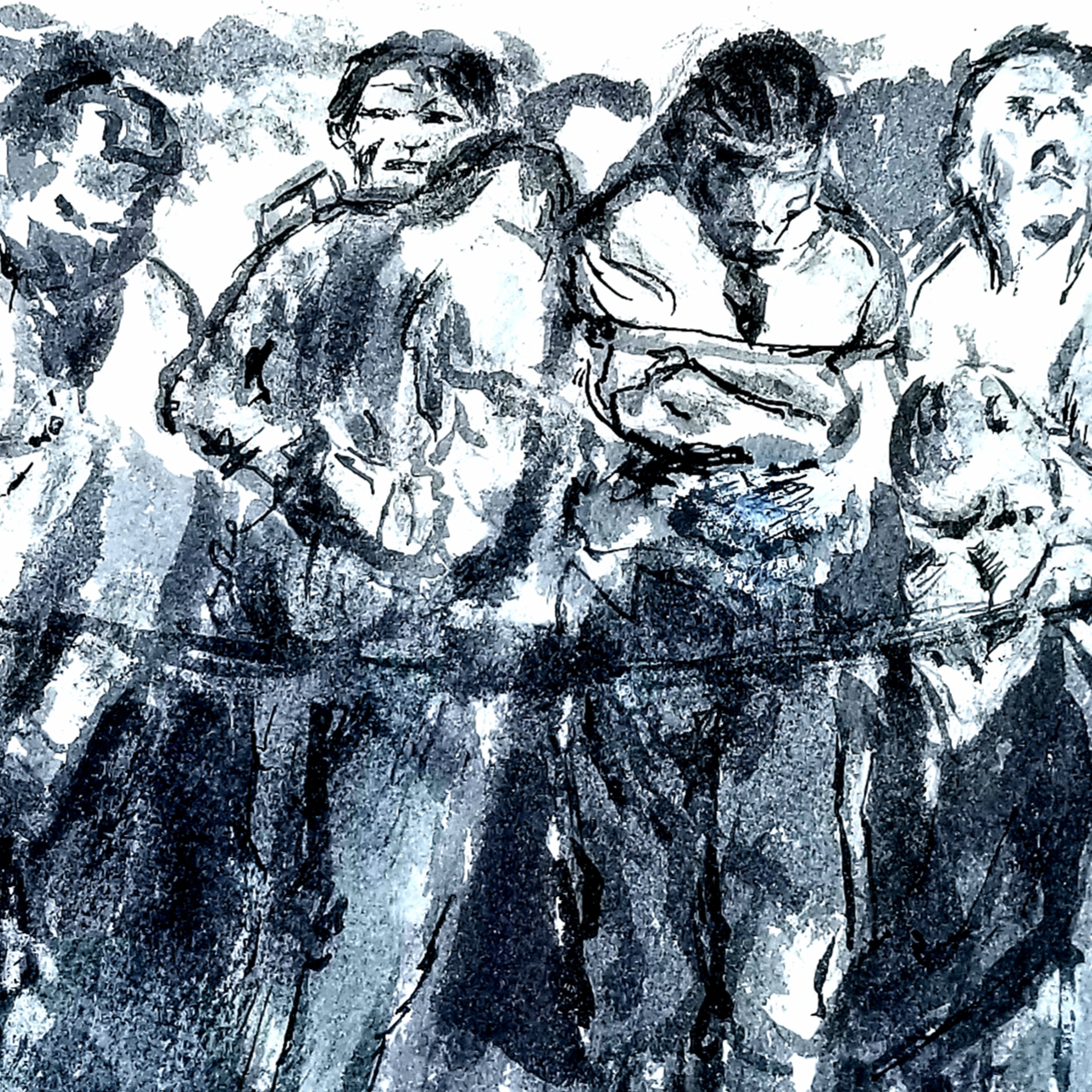
Kathe Kollwitz suffered the agonies of WWI before they happened. As a committed socialist and pacifist artist in the late nineteenth and early twentieth century, her art focused on the beauty and suffering of the working classes. She first came to know disadvantaged people in her father’s masonry workplace and later again in her physician-husband’s offices, where he treated the poor of Berlin, next door to her studio. She felt the daily grief of parents whose children succumbed to poverty and disease, and she used her son and herself as models for a piece portraying a grieving mother. In a bitter irony, this son died 10 years later in WWI.

I was drawn to explore two works from the Kollwitz series “The Peasants War,” from 1908. This masterpiece of etching imagines scenes from a revolt in 1524 that was taken as a model for rebellion until the French Revolution. Kollwitz used the past to grapple with the challenges of the present, and to foresee the future. Her work spoke powerfully to her own time and cries out to us in ours. In “After the Battle,” the scene of a bereft mother is almost too painful to behold; the viewer readily identifies with the searching mother. “The Prisoners” shows the aftermath of the failed revolt, yet the front-facing glare of the man in the center rear implies that this conflict is not over.

My renditions of Kollwitz’ etchings are in pencil and ink, yet remain faithful both to her rendition of the past to confront the present day, and to her devotion to graphic media, to drawing, as powerful tools for the dramatic evocation of emotion.
