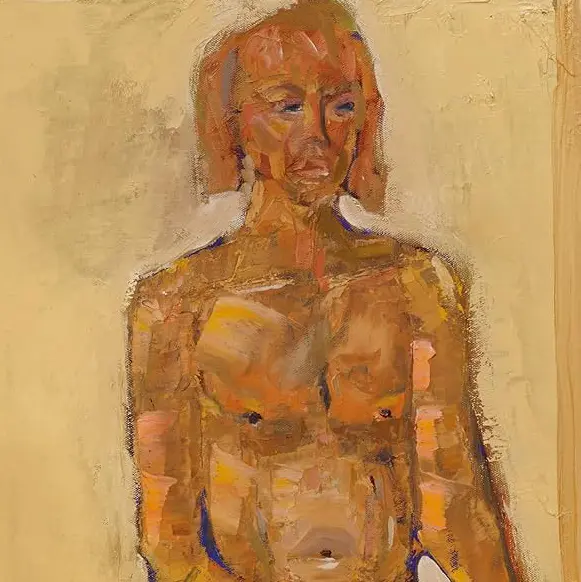
Surveying psychoanalyst Jade McGleughlin’s Clinical Storytelling, Art and the Problems of Being, subtitled The Analyst’s Necessary Vertigo (2024), I am struck by its title, the image on its cover, and the scope of its Routledge Relational Perspectives presentation. The publication opens with a series of rhapsodic blurbs by widely published and respected colleagues, hers and yours: Gonzalez, Grossmark, Cooper, Hartman, Guralnik, Corbett, and Harris, with a Preface by the latter.2
As the title implies, the author approaches problems of being through consideration of the challenge of faithfully rendering clinical experience; in particular, as she confirms, the difficulty of adequate description of working with patients “not structured within a linguistic frame.” (McGleughlin, p. 33). This leads to the cover image: the partial reproduction of an oil by the author, depicting a nude, square-shouldered androgynous figure, which I’ll identify as female, with terracotta-hued flesh. She appears melancholy, grim-faced, abject. Indeed, framed by a blank, yellow background, which ambiguously situates her in the corner of a room, she sits spindly-legged on a flat blackish-blue surface. This is a congealed base of emptiness, as revealed in the frontispiece of the text, an uncropped reproduction of the cover painting titled “Vertigo”.
Vertigo. Vertigo? Is the figure meant to embody vertigo or to induce it in the viewer? Is such a disjunction relevant to McGleughlin’s expressive aim? In any case, from her withdrawn expression, she seems statically resigned to the abyss rather than subject to paralyzing disorientation at the edge of a precipice. Alfred Hitchcock famously simulated such a state in the classic film Vertigo (1958) with a simultaneous high-angle, forward zoom and abrupt track-out of the camera as it presents the protagonist Scottie Ferguson’s (Jimmy Stewart) inward sensation as he glances down from the heights of a bell tower stairway. Scottie suffers from acrophobia, as depicted in the opening chase sequence of the film, when he helplessly witnesses a fellow policeman, attempting to rescue him from falling, fall to his death from the sloping roof of a San Francisco apartment building.
And what of vertigo conceived erotically? Consider Scottie’s bedazzled state when he first beholds Madeleine (Kim Novak), who positions herself (not incidentally, at the direction of another) to capture Scottie’s attention — as it does ours, as spectators, cued by the rapturous Bernard Hermann score. The second-wave feminist and psychoanalytic film critic Laura Mulvey (1975) coined the touchstone phrase “the male look”3 to identify this iconic moment and deconstruct the visual pleasure the image produces.4 When later in the film Scottie and Madeleine stand locked in a passionate embrace, the camera pans 360 degrees around them vertiginously, with images from earlier encounters projected behind their heads.
If vertigo is generated by the fear of heights and the lure of beauty, associating death by falling with desire, the film scenario can be summarized as a staging of the compulsion to repeat as Scottie is driven to master the Real of trauma in situations of danger. One thinks of Lacan’s (1978) formulation of the Real as that which always returns to the same place. Can we even begin to relate these symptoms and theoretical abstractions to the somber gravity of McGleughlin’s isolated figure? One perhaps suffering in a place well beyond the compulsion to repeat? To the problems of “being” (and most certainly, traumatic disruption thereof) that it is perhaps intended to depict?
Turning from the image to the challenge McGleughlin faced in putting words to her clinical experience:
[The] writing attempts to address my shift from the idea of a difficult-to-reach patient to the difficult-to-reach analyst….to reach toward a place of corresponding deficit in themselves, to sink into the foundations of their own (non)being….It [means] to convey an experience I could not narrate in any conventional form; that is to say, the feeling of drowning, inchoate sensation, and whirling vertigo that sometimes accompanied Sarah’s treatment. (p. 22; McGleughlin’s italics)
“Difficult-to-reach” in the case of Sarah, is characterized by her speechlessness:
…months at a time, five days a week. Time became psychotic. There were no facts, no history, no grounding narrative to hold onto. The treatment was the most tumultuous of my career…because of what the sustained and agitated silence did to me. (p. 21)
Note that McGleughlin doesn’t interpret her vertigo as Sarah’s projection of her inner state; it’s the enduring silence that seems to have agency in this doer-done to relation. Having nothing in the symbolic “to hold onto” nonetheless indicates that the analyst has been subjected to a situation of desperate precarity. As McGleughlin elsewhere in the text emphasizes the nonsovereignty of the analyst, we can couple “necessary vertigo” with disempowerment, a fall into a symmetric position with the patient – akin to the analyst being “destroyed” in the course of being “used” in Winnicott’s (1969) sense.
Comparing the void between analyst and patient to a plot development in Vertigo: after a (re)traumatizing repetition in which Scotty witnesses another death by falling, he’s hospitalized and has withdrawn into a catatonic state. His loving friend, the maternal Midge (Barbara Bel Geddes), attempts informal music therapy to rouse him, and, in one of the most poignant moments of the film, she leaves his room (and disappears from the narrative) mournfully saying, “Poor Scottie…even Mozart can’t reach you.” Another association to the film tracks Scottie’s pursuit of Madeleine, as she leads him from one well-known point of interest in the city to another; in particular, the Legion of Honor Museum, where, from a corner of a large gallery, he watches her, as she stares, as if in a trance, at the portrait of Carlotta Valdez, a beautiful but suicidal victim of colonialist patriarchy. (But that’s another story, though one subtly replayed in the Vertigo narrative.)
In the first account of the case of Sarah, “The analyst’s necessary vertigo,” the sequence of points of interest in Scottie’s pursuit of Madeleine are paralleled in McGleughlin’s text by an itinerary of clinical theories: one-person, two-person, object relational, self-psychological, and field theoretical. The author draws sustenance from these, like oases, in her struggle to engage with her patient. But none fully satisfies: “Our wildly disparate experiences caused a kind of vertigo. There was no consensual reality.” (p. 28) The theories, which do not escape Lacan’s (1999) adage that the Real never stops not being written, are analogous to “McGuffins,” Hitchcock’s terms for narrative ruses that temporarily fool the audience into thinking that they understand the intrigue.
In the second account of the Sarah case, titled “Love letter to a patient or the raw story,” which was really written first, McGleughlin’s brilliance as a psychoanalytic writer and self-declared clinical “bricoleur” (p.1), reveals itself, in mainly unsutured remnants of her painful work with Sarah, lines of poetry that express her yearning for rapport, and moments of profound distress and fear of failure.
I won’t spoil the suspense by revealing the astonishing conclusion of the first chapter, except to say that in response to Sarah, McGleughlin’s relational orientation disposes her to attend to the depths and wavering but resilient contours of a lifelong personal connection. There are words…necessarily autobiographical, autotheoretic, which she encapsulates by quoting the self-questioning of the poet Leroi Jones:
Who am I to love
so deeply?
References
Lacan, J. (1978). The Seminar of Jacques Lacan: The Four Fundamental Concepts of Psychoanalysis (Book XI). New York: W.W. Norton & Co.
Lacan, J. (1999). The Seminar of Jacques Lacan: On Feminine Sexuality, and the Limits of Love and Knowledge (Book XX). New York: W.W. Norton & Co.
McGleughlin, J. (2024). Clinical Storytelling, Art and the Problems of Being. The Analyst’s Necessary Vertigo. New York: Routledge.
Meltzer, D. and Williams, M.H. (2008). The Apprehension of Beauty: The Role of Aesthetic Conflict in Art, Development and Violence. London: Karnac Books.
Mulvey, L. (2009). “Visual Pleasure and Narrative Cinema,” in Visual and Other Pleasures (2nd Ed.). London: Palgrave Macmillan: 14-27.
Winnicott, D.W. (1969). “The Use of the Analyst”. IJP 50: 711-716.
