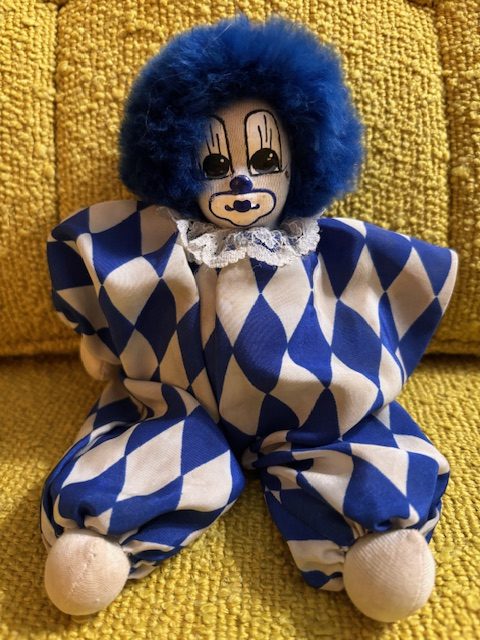
The body of my favorite doll was made of cloth, filled with hard-packed sand, and doused in ripples of a silk, cerulean blue and white checkered suit with lace around the neck. Unlike the Barbie dolls I so often received as gifts, it carried no suggestion of what I needed to aspire to be or take care of. His blue button nose was painted onto a simple white cloth stretched over a wooden head with plump cheekbones. White paint and a blue outline surrounded his bow-shaped, blue mouth in true clown fashion. Staring into those huge, long, reassuring eyes on the sunken contours of his face, I could not look away. He looked expectant, like he wanted to listen to anything I had to say. When I discovered him hiding out in the display of porcelain knick-knacks at the Hallmark store, I danced on tip toe. He seemed to watch me with curiosity, waiting to see what I’d do next. My mother’s desire to protect me from materialism was no match for the ardor with which I begged for the doll. I could see the puzzlement, but also amusement, on her face as she considered my request during a trip to purchase cards.
“Are you sure? You think you’d really use this?”
“Definitely.”
She seemed tongue-tied, unable to argue, perhaps a bit endeared to the sight of the little thing or taken with my immediate connection with it.
“Okay… I guess we can get it,” she agreed with a half smile.
He came with me to recess promptly the next day. I took him out of my sleeve once I reached my usual spot at the edge of the sandbox.
“Oh, what’s that?” Sade called as she ran to me.
I held him up for her examination. The dramatic power of his gorgeous, blue and white aesthetic washed over her with palpable force. She almost fell over backward. I caught her by the wrists, pulled her back in to me, and she steadied herself. “Wowww,” she breathed as we both felt his hair. “So soft!” We squealed in unison.
The scene radiated across the playground, attracting attention from more kids than I ever had in all of my seven years. A crowd formed around me, and the amalgamation of all the arms reaching in underneath my arms, as I held him up high, nearly lifted me off the ground. They stroked his synthetic hair as I described its texture as “somewhere between feathers and rabbit’s fur.”
“Ooooooooh…” they breathed.
An enraptured giggle escaped me.
“It is so soft!”
“It’s a fro!”
“A fro?”
“What did you name ‘im?”
“Clown, of course!”
“Oh! That’s boring!”
“You should name him Oxford.”
“No, I like Clown.”
“Isn’t Oxford the name of a comma? That’s weird.”
“It’s sophisticated!”
“Where’d she come from?”
“He fell from a cloud,” I blurted.
“Wait—what??” Sade laughed. I slipped her a knowing look before continuing.
“Well, he was snowboarding over the clouds, and he hit a huge jump. It was crazy!
He went over the whoooole cloud. Then he started to topple down and down and down….. until…I caught him!” I said, snatching the clown back and drawing him to my chest for a hug.
“This is weird,” a girl wearing pink jelly sandals said. “That definitely can’t be true. Let’s go.” She turned her back and about a dozen girls followed her back to the concrete. But over half a dozen girls remained.
“No—really,” said Sade. “Where’d you get him?”
“At the Hallmark store down the street!”
In a matter of days, more clown dolls appeared at school—one with billowy red hair and a white suit peppered with red hearts, another with a light turquoise afro and a suit pattern reminiscent of rainbow birthday cake sprinkles and ribbons, then still another decorated in shooting stars, that one a perfect match for Mina, who liked to pretend to be a horse who only knew how to canter, not to walk or trot. Sade’s had a black suit and black hair, with hot pink pinstripes and buttons down the front, its assertive coloring matching the way she seemed to tromp when she walked through the mud. At recesses, we began to gather under a small, spindly, dying tree, rich in lacy bark and easy to climb, where the ground had been hollowed out in the shape of a large spoon, just big enough to hold us. We galloped from tree to forest and back, pretending to be ridden by little clowns on our backs. Often, a giddy energy would burst out of my legs as we galloped around, and I’d sprinkle in a few leaps along the way. Each night, the rains washed away the flowers we laid down on the floor underneath the tree to demarcate imaginary pieces of furniture, but that didn’t diminish the growing sense of familiarity within the spaces between each of us, nor did it stop our growing world of unspoken rules and routines. Jess always played the horse of the group, I made the muffins and the tea for story time, and Sade proclaimed each day that she would go and tend to the hunting. After a few weeks, the girl wearing pink jelly sandals walked over to us from the middle of the concrete, where the rest of the children usually gathered for double dutch and hopscotch.
“What are you doing?” She asked.
“We’re just playing clowns,” I answered frankly.
“Oh,” she said, staring.
“What?” I challenged.
“You’re acting like these clowns are real. They’re just bags of sand.”
For a flash of a second, I felt exposed, like I was supposed to have grown out of everything that I loved already, but I quickly sensed her animosity was not truly towards me. It was towards our independence. “Who cares,” I said. She continued to stare before tossing her long hair over her shoulder and walking back to the rest of the kids. The next day, Sade and I were walking to the tree, talking about whether to make flower tea or magic potion tea at the tree that day, when suddenly, we spotted the pink jelly sandal girl and some of her friends gathering beneath our familiar branches. I gasped. It looked so odd, seeing these girls sitting under our tree with docile postures, talking quietly. Then they pulled out their Barbies from their pink pony backpacks. I stopped dead. Barbie repelled me. The mere sight of her womanly yet girlish body fragmented my spirit and nearly erased something important inside me whenever I had glimpsed her at the bottom of our toy chest. The impossibility of her form amplified a message I’d heard from countless voices, magazine covers, TV shows, movies, illustrations in books: that female bodies must fit within certain physical bounds or be left alone. I wanted to defy the very existence of that prison, yet I already felt trapped inside it whenever my mother took me to the store to buy clothes. Without realizing, I kept walking towards the Barbies, but I arched my path to stay out of the girls’ field of view. As I drew closer, I heard one of them, describing her Barbie to another, say, “Just pretend she is the big, huge one. She’s quiet. She’s, you know, like that girl in our class Amy!” Shrieks and giggles punctuated the statement. They went on like that for a while as I walked away. I felt so hot and sad that I could barely get out the words “it’s taken,” when I got back to my friends.
“What?!” Mina said.
“Our tree is taken. We’ll have to be faster tomorrow.”
They all looked up, saw the group with Barbies clustered in the distance under our tree, and their faces dropped.
“What the heck!?” Jess said. “They know that’s our tree!”
“I know.”
That night, I moved slowly, feebly, when taking off my shoes. “What—are you 75?” My mother joked with me. I couldn’t laugh. Dinner was tasteless, and I could hardly chew anyway. Climbing up the stairs to my bedroom, my legs felt drained. It was difficult to imagine protecting our territory against forces so much larger than ourselves. The next morning, I reminded each of my friends of the plan we had agreed to the prior day. When the morning recess bell began to ring, the seven of us grabbed our clowns from under our desks and sprinted out the door. We arrived at the familiar enclave gasping for air, breathing sighs of relief.
“We’re free!” Sade yelled.
“We’re free, we’re free, we’re free, we’re free!” We all yelled back, raising our clowns in the air as we all jumped up and down laughing. Then, with an electrified focus, I led us in the commencement of our routine of talking in high pitched clown voices, pretending to make our clowns discuss what we would do that day—who would do the hunting, collect the flowers for the kitchen table and the berries for the pies, and who would do the cooking, as well as which clowns felt they simply needed to climb the tree. Over three decades later, I still feel a strong connection to that little wide-eyed face, which stares up at me here at my desk. When I take him in my palm and run my fingers over his sandbag body, there is now a soft spot where a heart would be. I remember placing my thumb over that spot so many times when it first appeared in childhood, mesmerized by the connection it represented. That familiar soft spot, like the enclave under our tree, brings me back to my creative self. On the other side of that world we created, lost are the companions who ran alongside with their dolls. Yet I still cling to that world, and to those who wish to create something different from the rest.
Free Enclave
The body of my favorite doll was made of cloth, filled with hard-packed sand, and doused in ripples of a silk, cerulean blue and white checkered suit with lace around the neck. Unlike the Barbie dolls I so often received as gifts, it carried no suggestion of what I needed to aspire to be or…
7–10 minutes