Where do the boundaries lie between the visible and the invisible? Our sense of the visible is shaped by the limitations of our physical perception, as it is by the scope of where we choose to direct that vision. Photography has extended the capacity of human vision on both counts since its origins.

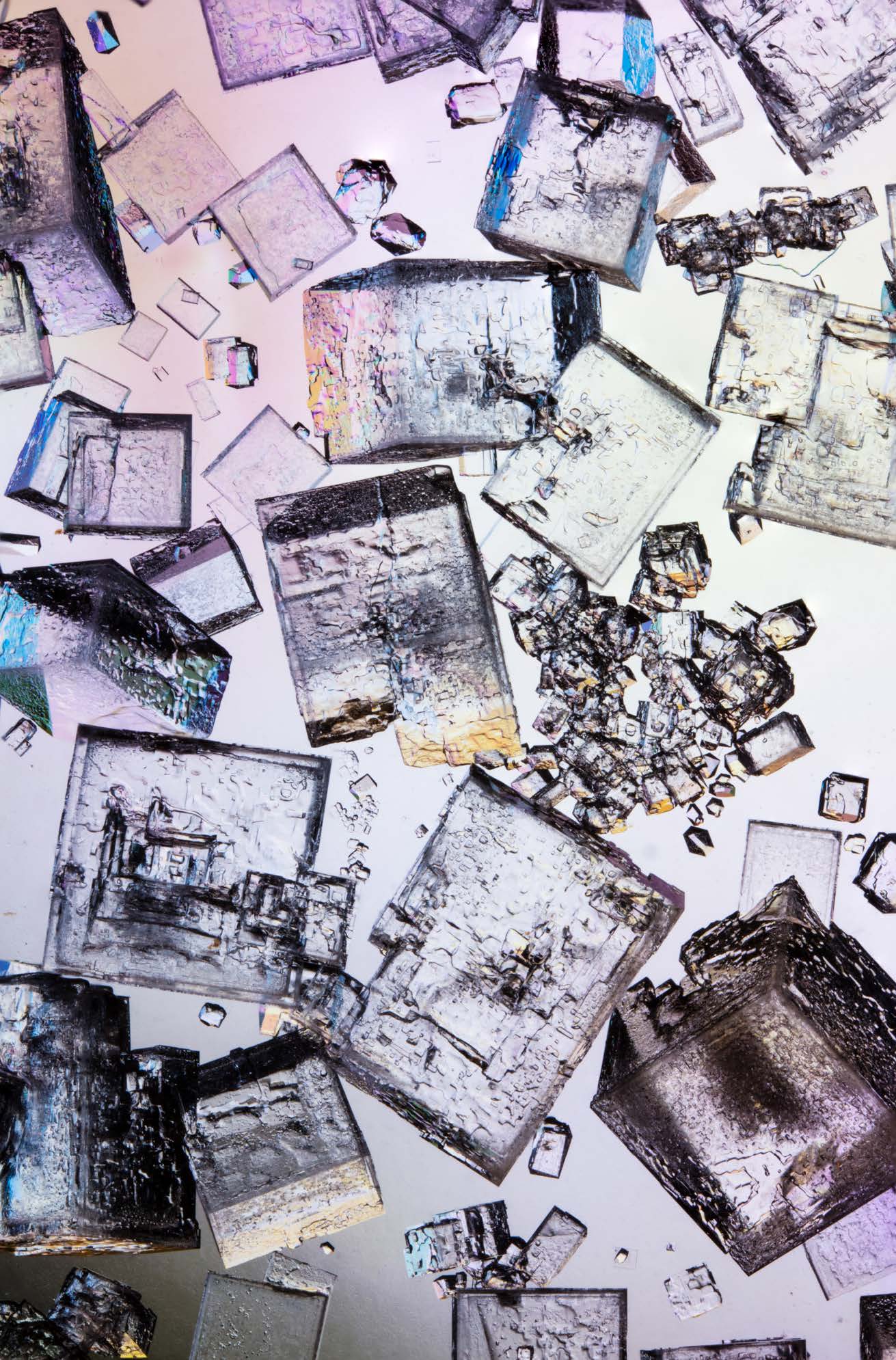
In my photography, I work with commonplace things that shift in and out of visibility, and I’m particularly interested in salt and plastics. These photographs are part of a project that looks at salt and plastics up close, through methods that dodge some of the limits of human perception. The shapes seen here are salt crystals, illuminated with polarized light, which is filtered through layers of transparent, disposable plastics. Wildly unpredictable colors result from the way plastics bend the polarized wavelengths, and sometimes make visible patterns within the plastics themselves. In the process, salt and plastic collaborate in refraction, creating shimmering, gravity-defying fields that evade our sense of scale.

The title of this series is Halophilic 2: On a Molecular Level. The word “halophilic” is used in the natural sciences to describe creatures that thrive in a saline ecosystem. In terms of geology, salt deposits in the earth are often near neighbors of petroleum; the entanglement of these two materials moves into new levels as they are extracted and processed for our use. We’re all as familiar as we can be with salt; it brings to mind appetites, tears, sweat, and the sea, and references to salt abound in our poetry and figurative language. The flow of salt through our bodies is essential to our health. In our time, plastics are as ever-present as salt, and nowhere near as benign, or as well understood.

Salt and plastics intermingle as they pass through our systems day by day. We know salt as a material of the earth and the sea; plastics are likewise an end-product of industrial-scale extraction. By the time they reach our hands, processes of production have removed any trace of the earth from which they came—the earth in which they remain entangled far beyond the moment of use. These materials are part of our world at every level, from the geological to the most minuscule we can imagine. Today, the exploitative practices that created the modern era have positioned us in a ravaged earth where “forever chemicals” suffuse the water and the air.

How can we imagine a future in a world that is infused with plastics at every level? Our human senses, and our personal frames of reference, are limited. Photography can bring us ways to bypass those limits.
Images can reorient our perspective on our place in the earth and in a history that we participate in, which stretches beyond our threshold of perception. From where we stand, the materials of our lives can become reminders to be open to the light as it reaches us—and to seek a poetics of transformation that can keep us looking forward with hope.

